
 Guest Contributor
The advanced nuclear reactors currently under development are being designed to eliminate the factors that led to past accidents, preventing future failures.

State Rep. Michael Carbone and state Rep. James Taylor. Photo via azleg.gov.
What if we could have the benefits of nuclear energy without the safety risks historically associated with a potential meltdown? That is what the next generation of advanced nuclear reactors is designed to achieve.
In the 1960s, Americans understood the benefits of nuclear energy: abundant power, reliable generation, and affordable rates. Over time, that confidence gave way to concern. Cold War fears, school drills, air raid sirens, and emergency broadcasts shaped daily life, while accidents at Three Mile Island, Chernobyl, and Fukushima became fixed in the public consciousness.
Fears of radioactivity and nuclear fallout sparked protests and public opposition, leading countries like Germany to dismantle reactors that were operating safely. Those memories linger today and often fuel organized resistance in local communities whenever new reactors are proposed.
The fear is understandable. Lives were lost, radiation was released, and entire communities were evacuated, with some residents never able to return. As tragic as those incidents were, it is important to understand why they occurred and why modern reactor designs address the specific failures that caused them.
Here are the facts. Three Mile Island involved a valve failure combined with operator error that caused a partial meltdown, not a nuclear explosion. Chernobyl resulted from a fatal design flaw and a reckless test that triggered a large steam blast, not a nuclear detonation. Fukushima followed a massive loss of power and cooling after a tsunami, which led to hydrogen buildup, not a nuclear chain reaction.
In every case, the damage came from pressure, steam, or hydrogen gas buildup, not from the uranium fuel itself. When reactive cladding and high-pressure water are removed, the conditions required for an explosion are greatly reduced. That is precisely what the next generation of advanced reactors is designed to do.
Flibe Energy, backed by former Oak Ridge scientists, uses a thorium molten salt reactor in which the fuel is already liquid. If temperatures rise too high, the fuel is designed to drain passively into cooled containment tanks, ending the reaction by design. There are no fuel rods and no high-pressure water systems, substantially reducing the risk of a traditional meltdown.
TerraPower’s Natrium reactor, backed by Bill Gates and the U.S. Department of Energy, uses sodium cooling with passive circulation. Heat is designed to dissipate naturally without pumps or external power. The reactor contains no high-pressure water and relies on self-regulating physical properties to manage heat.
X-energy’s Xe-100 reactor, backed by Amazon and Dow Chemical, uses helium as an inert coolant along with TRISO ceramic fuel. Each fuel particle acts as its own containment system and can withstand temperatures far higher than those tolerated by conventional reactors. The absence of fuel rods and high-pressure water is intended to allow the reactor to shut down safely without operator action and to be “walk-away safe.”
These designs greatly improve safety by addressing the conditions that contributed to past accidents. Liquid fuel avoids rod failures. The absence of pressurized water limits steam-related damage. Inert coolants and non-reactive materials reduce hydrogen formation. Passive cooling allows heat to move away from the core without pumps or operator intervention. Ceramic fuel layers tolerate extreme temperatures without structural failure. Together, these features are intended to prevent the types of failures seen in earlier generations of reactors.
Nuclear power has advanced considerably, and despite past incidents, it has ranked among the safest sources of electricity over decades of use. At roughly 0.03 deaths per terawatt-hour produced, nuclear power compares favorably with wind at 0.04 and solar at 0.02, based on published data. Those figures reflect long-term operating experience across multiple countries.
The United States has also operated compact nuclear reactors aboard military submarines for more than 70 years without a reactor meltdown or radiological accident affecting the public. That history reflects conservative engineering standards and rigorous operational oversight.
For those who grew up during the Atomic Age, the concerns that once caused anxiety have driven changes in reactor design and safety philosophy. Modern systems reflect lessons learned over decades of research, testing, and operation.
Advanced nuclear technology offers the opportunity to expand clean, reliable power while addressing longstanding safety concerns. If built and operated as designed, these reactors could play a critical role in meeting future energy needs without repeating the failures of the past.
Michael Carbone is a Republican member of the Arizona House of Representatives serving Legislative District 25 which includes portions of Yuma, Maricopa, and La Paz Counties. He also serves as House Majority Leader. Follow him on X at @MichaelCarbone.
James Taylor is a Republican member of the Arizona House of Representatives serving Legislative District 29 in the West Valley, Goodyear, and Surprise.
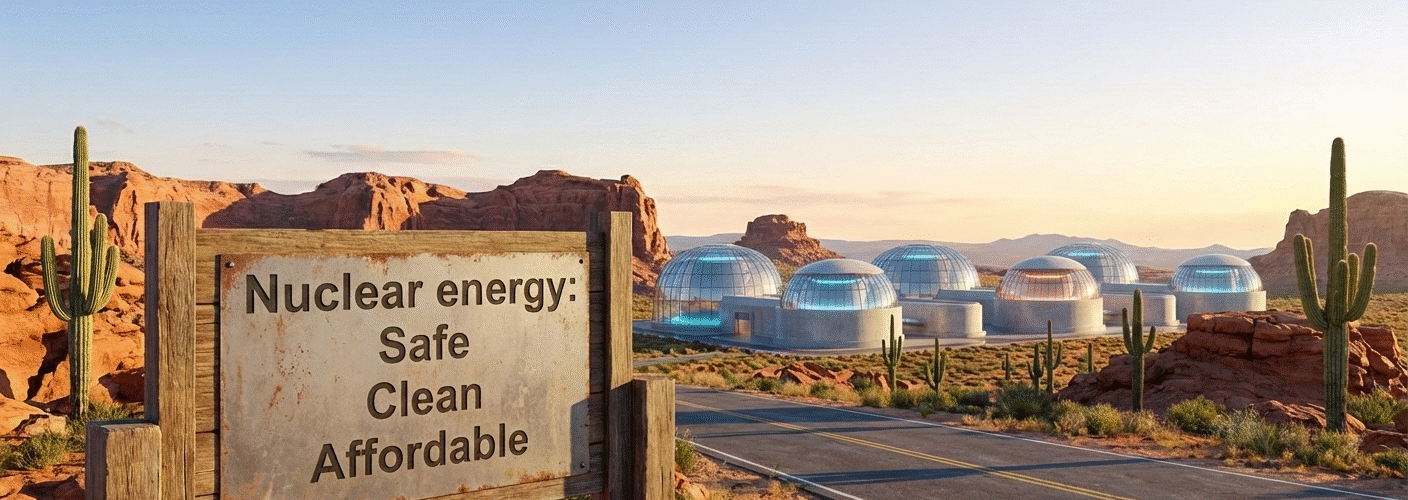
Cover image via Gemini


 Chamber Business News


Add comment